Choosing the right Aluminium Washroom Door involves more than comparing finishes, prices, and catalogue photographs. In busy commercial washrooms, the door may face constant opening cycles, moisture, cleaning chemicals, and accidental impacts. A practical assessment should examine the complete system: aluminium grade, frame strength, hinge performance, privacy hardware, ventilation, and installation quality. The choice is less obvious than it appears.
Industry data supports aluminium’s long-term value. The International Aluminium Institute reports that nearly 75% of all aluminium ever produced remains in productive use today. Its Aluminium Sector Greenhouse Gas Pathways to 2050 also highlights aluminium’s recycling potential and circular-material advantages. However, these benefits depend on responsible sourcing and proper end-of-life recovery. A durable door is not automatically a sustainable door.
The Grand View Research Aluminium Market Size, Share & Trends Analysis Report identifies continued global demand for aluminium across construction and building applications. That trend reflects its light weight, corrosion resistance, and design flexibility. Yet washroom conditions expose weak specifications quickly. A thin panel can flex near the handle. Poorly protected edges may show damage after repeated cleaning. Unsealed joints can collect dirt behind the frame. This guide considers those details carefully, while recognising one uncomfortable truth: no specification can compensate for careless installation. It will explain how to compare materials, dimensions, hardware, privacy levels, maintenance needs, and total ownership cost before selecting an Aluminium Washroom Door for a reliable commercial environment.
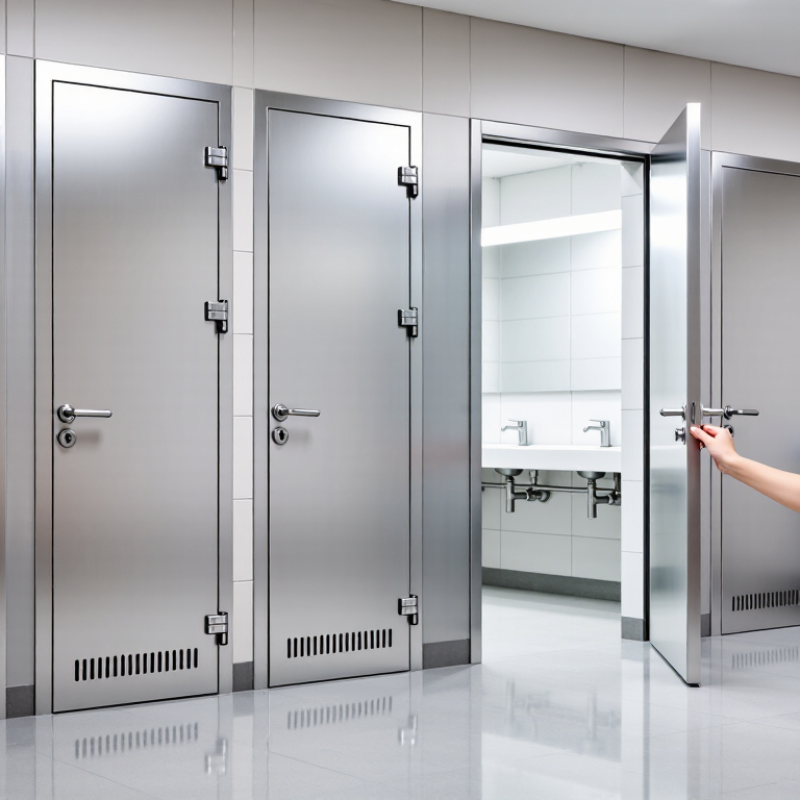
Define Your Washroom Door Requirements and Usage Conditions
Choosing the best aluminium washroom door starts with usage, not appearance. Record daily traffic, peak periods, user types, and cleaning routines. A school washroom may need impact resistance, while a hotel requires quieter closing and stronger privacy. Clinics need surfaces that tolerate frequent disinfection. The World Health Organization’s 2022 Global Report on Infection Prevention and Control notes that effective programmes can reduce healthcare-associated infections by up to 70%. This supports specifying smooth, sealed door surfaces with fewer dirt-trapping joints.
Measure the opening carefully. Under ICC/ANSI A117.1 accessibility provisions, many accessible doors require at least a 32-inch clear opening. Check the actual wheelchair route, turning space, threshold height, and door swing. Peak traffic also matters. A light-duty hinge can fail quickly in a busy station. It happens more often than expected. For humid rooms, ask for corrosion-resistant aluminium finishes, stainless-steel fixings, and hardware tested for repeated cleaning. EN 1670 classifies corrosion resistance for building hardware, but the door assembly still needs practical site testing.
Think about the cleaning team’s experience. Can they wipe the lower 300 millimetres without damaging the finish? Will water collect near the threshold? Specify rounded edges, replaceable seals, and adjustable closers where possible. Avoid choosing only by thickness or price. My own preference would change after observing one week of real use, because drawings rarely show wet floors, slammed doors, or rushed maintenance. Reliability is measured in those ordinary moments.
How to Choose the Best Aluminium Washroom Door? - Define Your Washroom Door Requirements and Usage Conditions
| Requirement or Usage Condition | Recommended Aluminium Door Specification | Practical Selection Data | Why It Matters |
|---|---|---|---|
| Frequent public use Shopping centres, schools, transport facilities, and offices |
Use a robust commercial-grade frame with reinforced hinges, a heavy-duty closer, and replaceable hardware. | Select hardware tested for high-cycle operation and specify a door closer suitable for the door mass and width. | High traffic increases wear on hinges, pivots, latches, and handles. Replaceable components help reduce maintenance downtime. |
| Wet or splash-prone areas Showers, pool facilities, gyms, and changing rooms |
Choose corrosion-resistant aluminium with a durable anodised or powder-coated finish, stainless-steel compatible hardware, and moisture-resistant seals. | Provide drainage at the floor and avoid designs that trap standing water around the threshold or frame. | Continuous moisture and cleaning chemicals can accelerate corrosion and coating deterioration if water is not drained properly. |
| Coastal or high-salt environment Buildings near the sea or saltwater pools |
Specify a finish and hardware package rated for marine or high-corrosion exposure, with isolation between dissimilar metals. | Use compatible fasteners, rinse salt deposits regularly, and inspect exposed edges and fixings. | Salt deposits increase the risk of surface attack and galvanic corrosion, particularly where different metals contact each other. |
| Privacy requirement Toilets, shower rooms, and healthcare washrooms |
Use an opaque or privacy-glazed infill, a functional indicator bolt where appropriate, and controlled door gaps. | Confirm the required privacy level, sightline control, emergency-release arrangement, and ventilation strategy before ordering. | Privacy needs vary by building type. Emergency access must not be compromised by the lock or indicator design. |
| Accessible washroom Wheelchair-accessible or assisted-use facilities |
Use a lightweight door leaf where possible, easy-grip hardware, sufficient maneuvering space, and a closer adjusted for manageable opening force. | Set the clear opening, thresholds, handles, closing force, and turning space according to the applicable local accessibility code. | Door width and opening force affect independent use. Exact requirements differ by jurisdiction and building type. |
| Typical internal washroom Residential, hotel, and low-to-medium traffic applications |
Use a standard aluminium frame, moisture-resistant infill, adjustable hinges, and a durable latch set. | A common planning range is approximately 700–900 mm door leaf width and 2,000–2,100 mm height, subject to local design requirements. | Standardized dimensions simplify installation, replacement, and coordination with partitions and sanitary fixtures. |
| High humidity and poor ventilation Enclosed washrooms with limited air movement |
Choose moisture-resistant infill materials, corrosion-resistant hardware, and a finish that can be cleaned without abrasive methods. | Provide mechanical or natural ventilation as required and keep regular inspection intervals for hinges, locks, and frame joints. | Persistent condensation can affect hardware, seals, coatings, wall interfaces, and indoor hygiene conditions. |
| Easy cleaning and hygiene Healthcare, food-service, and high-contact facilities |
Select smooth, non-porous surfaces with minimal dirt-collecting joints and hardware that tolerates the approved cleaning products. | Confirm chemical compatibility with the coating, seals, laminates, and metal surfaces. Avoid unapproved abrasive cleaners. | Cleaning chemicals and aggressive scrubbing can stain, dull, or damage finishes that are not chemically compatible. |
| Noise control Hotels, offices, and residential developments |
Use perimeter seals where compatible with the door system, a controlled closer, and a latch that engages without slamming. | Treat acoustic performance as a complete wall-and-door assembly requirement rather than relying on the door leaf alone. | Gaps, ventilation paths, lightweight partitions, and uncontrolled closing can limit overall sound reduction. |
| Fire, smoke, or special safety requirements Commercial and multi-storey buildings |
Use only a door assembly that has the required documented fire, smoke, or safety classification for the specific installation. | Verify certification, frame compatibility, glazing or infill limits, hardware, installation method, and local authority requirements. | A standard aluminium washroom door should not be assumed to provide fire or smoke resistance without assembly-specific evidence. |
| Maintenance budget and service life Projects seeking lower total ownership cost |
Choose modular components, accessible adjustment points, replaceable seals, and readily available hardware sizes. | Create an inspection schedule covering fasteners, hinges, closers, locks, seals, drainage, and coating condition. | Routine cleaning and timely hardware adjustment can extend serviceability and reduce the need for complete door replacement. |
Note: Door dimensions, accessibility provisions, fire requirements, ventilation, and hardware performance should be confirmed against the building location’s applicable codes, standards, and project specifications.
FAQS
A reinforced hinged door often provides dependable daily performance. It opens simply and cleans easily. Check twice. Sliding doors save floor space, but tracks collect dust and moisture. Folding doors suit narrow openings, though their hinges need regular adjustment.
Choose sliding construction when floor space is limited. Inspect the track carefully before ordering. Dust and moisture can gather there. Cleaning may become more demanding. The door should move smoothly without rattling or sticking.
Anodised aluminium resists surface wear and keeps a metallic appearance. Powder-coated aluminium provides more colour choices and hides minor scratches. Request a physical sample. Screen colours can be misleading.
Ask about frame thickness, corner joints, and internal reinforcement. A lightweight panel may flex after repeated use. That movement becomes irritating. Examine the bottom edge for moisture protection. Strong construction should feel firm, not hollow or loose.
Check whether hinges use stainless steel or another corrosion-resistant alloy. Test the lock before ordering. The closing action should feel controlled, not harsh. Weak hinge fixing can require early adjustment. I once overlooked that detail.
The frame should be plumb, firmly anchored, and sealed against damp walls. The door must swing without scraping the floor. Measure after wall finishes are complete. Small measurement errors can create expensive adjustments. Ask for written specifications and inspection records.
Check coverage for the frame, hinges, surface finish, lockset, and installation labour. Read every exclusion carefully. Common exclusions may include corrosion, misuse, harsh cleaning products, or water damage. Ask how quickly repairs are handled. Confirm that replacement parts remain available.
Include delivery, wall preparation, installation, maintenance, and future repairs. Compare at least three written quotations. The cheapest quote may not cost least later. Leave a small contingency budget. Older walls rarely measure perfectly.
Conclusion
Choosing the right Aluminium Washroom Door begins with understanding the space, frequency of use, humidity levels, and expected traffic. Consider whether the door is intended for a home, office, commercial facility, or public washroom, as these conditions affect the required strength and design. Compare different aluminium profiles, panel options, finishes, and construction methods to ensure the door offers reliable performance without unnecessary weight or cost. A well-made door should resist moisture, corrosion, impact, and daily wear while remaining easy to clean and maintain.
Pay close attention to door dimensions, frame compatibility, hinges, handles, locks, and privacy requirements. Ventilation gaps or integrated vents may also be useful where airflow is important. Professional installation helps ensure smooth operation, proper alignment, and long-term stability. Finally, review warranty terms, replacement support, maintenance expectations, and the total project cost rather than focusing only on the initial purchase price. Balancing quality, safety, practicality, and budget will help you select an Aluminium Washroom Door that remains functional and attractive over time.
