Engineered Aluminium Clad Timber Window Series
Explore our factory-direct, high-performance fenestration products tested for thermal isolation, structural durability, and extreme weather resilience.
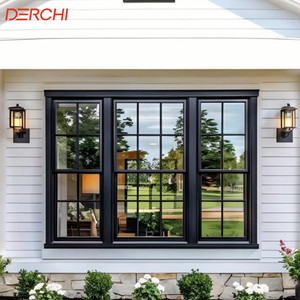
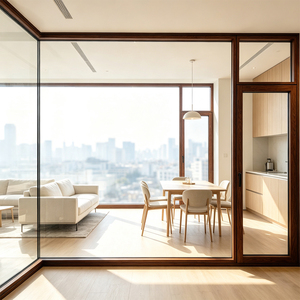
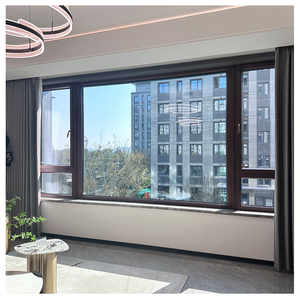
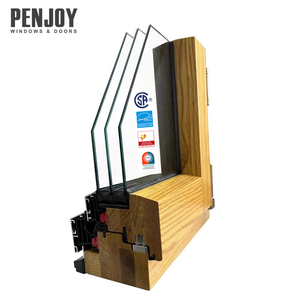
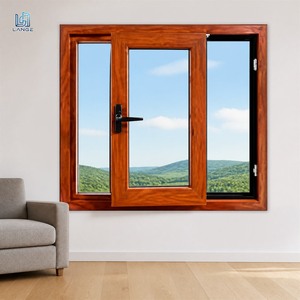
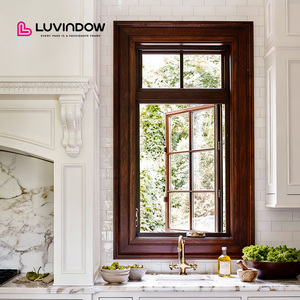
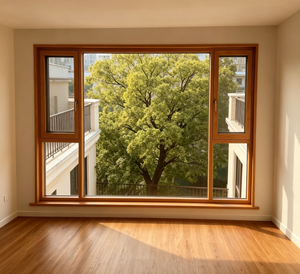
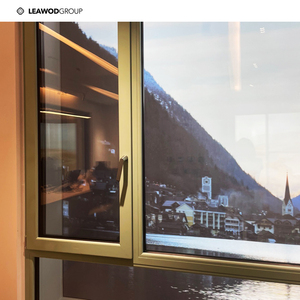
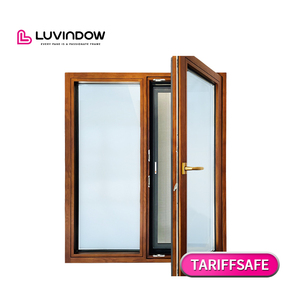
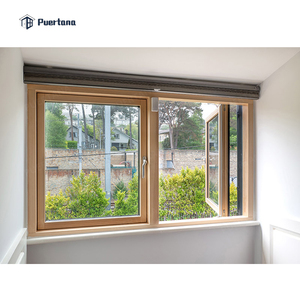
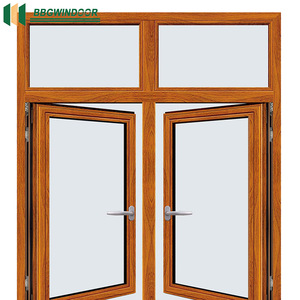
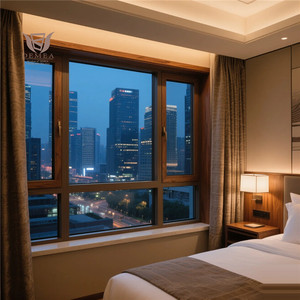
1. Technical Engineering Architecture of Aluminium Clad Timber Windows
Aluminium clad timber windows represent the pinnacle of modern architectural fenestration engineering. By combining the internal organic aesthetics and exceptional thermal resistance of solid timber with the exterior durability and weather resistance of extruded aluminum, hybrid windows resolve the historical compromises inherent in single-material window systems. In luxury residential development, passive house construction, and high-end commercial facades, aluminium clad timber serves as the benchmark specification for structural longevity, energy conservation, and architectural flexibility.
At the core of a high-performance aluminium clad wood window is the principle of thermal isolation and stress-free composite assembly. Timber possesses a naturally low thermal conductivity coefficient ($\lambda \approx 0.12 \text{ to } 0.15 \text{ W/m}\cdot\text{K}$), making it an outstanding natural insulator. However, bare timber exposed to external ambient elements undergoes dimensional fluctuations caused by relative humidity changes, solar ultraviolet radiation, and water absorption. Conversely, aluminum alloy extrusions ($6063-\text{T5/T6}$) offer structural stiffness and total immunity to UV degradation, but exhibit high thermal conductivity ($\lambda \approx 160 \text{ to } 200 \text{ W/m}\cdot\text{K}$).
Information Gain Metric: Differential Thermal Expansion Mechanics
Direct bonding of wood to aluminum causes structural shear stress because aluminum expands at $\alpha \approx 23 \times 10^{-6}/\text{K}$ while wood expands lengthwise at only $\alpha \approx 4 \times 10^{-6}/\text{K}$. Factory-engineered systems utilize high-density polyamide (PA66) sliding clips that create a tension-free structural air gap (typically 5mm to 8mm), allowing the exterior aluminum cladding to expand and contract independently of the inner timber frame without warping or inducing seal degradation.
Our manufacturing process utilizes specialized multi-layer finger-jointed laminated wood profiles (larch, northern pine, or red oak) treated via vacuum drying to maintain an absolute moisture content between 8% and 12%. This structural stabilization prevents internal stress cracking. The exterior aluminum jacket is powder-coated using architectural-grade fluorocarbon or AkzoNobel electrostatically applied powders, certified to withstand 3,000 hours of continuous salt spray exposure under ASTM B117 standards.
2. CE Certification Standard (EN 14351-1) & Global Regulatory Compliance
For B2B importers, architectural specifiers, and commercial general contractors, regulatory compliance is non-negotiable. The European Standard CE EN 14351-1 specifies performance characteristics for windows and external pedestrian doorsets. Achieving CE compliance requires stringent Factory Production Control (FPC) and third-party Initial Type Testing (ITT) performed by accredited notified bodies.
| Performance Testing Standard | Tested Parameter / Protocol | CE EN 14351-1 Benchmark Classification | SAGA Direct Factory Achieved Level |
|---|---|---|---|
| EN 12207 | Air Permeability / Air Infiltration | Class 1 to Class 4 | Class 4 (Highest Tightness, < 0.75 m³/h·m²) |
| EN 12208 | Watertightness under Dynamic Pressure | Class 1A to Class 9A / Exxx | Class E1200 (1200 Pa No Water Penetration) |
| EN 12210 | Resistance to Wind Load (Deflection) | Class A1 to Class C5 | Class C5 (High-Rise & Coastal Structural Wind Load) |
| EN ISO 10077-2 | Thermal Transmittance ($U_w$ Value) | $U_w \le 1.4 \text{ W/m}^2\text{K}$ | $U_w = 0.75 - 0.85 \text{ W/m}^2\text{K}$ (EnerPHit Level) |
| EN ISO 140-3 | Acoustic Attenuation ($R_w$ Rating) | $R_w \ge 30 \text{ dB}$ | $R_w = 42 - 47 \text{ dB}$ (Triple Sealed Glass) |
In addition to European CE certification, our enterprise maintains rigorous quality compliance across major export jurisdictions:
- Australia & New Zealand: Audited under the AGWA compliance program for AS2047:2014 (Windows in Buildings), AS1288:2021 (Glass in Buildings), and New Zealand NZS4211:2008 covering NZ Building Code clauses B1 (Structure), E2 (External Moisture), and H1 (Energy Efficiency).
- North America: Tested according to the North American Fenestration Standard (NAFS AAMA/WDMA/CSA 101/I.S.2/A440) for structural wind pressure, water entry, and forced-entry resistance.
- Hurricane Zones (Florida & Caribbean): Select product lines pass Miami-Dade County Protocols TAS 201 (Large Missile Impact), TAS 202 (Uniform Static Air Pressure), and TAS 203 (Cyclic Wind Pressure Loading).
3. Material Science: Timber Selection, Finishing, and Glazing Systems
The operational lifespan of an aluminium clad timber window depends significantly on raw material selection and surface chemistry. As a factory supplier, we implement strict raw material qualification protocols across all components:
Timber Species Engineering
We work with three primary structural timber species, each selected for specific mechanical properties:
- Siberian Larch (Larix sibirica): Characterized by high density (~590 kg/m³) and natural resin content, offering inherent decay resistance and superior compressive strength. Larch is ideal for high-humidity and sub-zero climates.
- Northern European Red Pine (Pinus sylvestris): Highly stable with uniform grain structure. Excellent absorbency for water-borne eco-coatings, making it the preferred choice for modern minimalist interior finishes.
- American Red Oak (Quercus rubra): Premium hardwood option (~750 kg/m³) exhibiting exceptional hardness, luxury grain depth, and maximum screw-holding power for heavy architectural hardware.
TEKNOS Water-Based Eco-Friendly Coating Line
To ensure toxic-free indoor air quality and protect timber against fungal rot, blue stain, and UV degradation, frames undergo a automated 4-stage TEKNOS water-borne finishing process:
- Deep Vacuum Impregnation: Fungicidal and bactericidal protection penetrating deep into wood pores.
- Pore-Filling Primer: Equalizes surface tension and enhances topcoat adhesion.
- Intermediate Tinted Coating: Provides color depth and UV-blocking pigment distribution.
- High-Elasticity Topcoat: Forms a breathable, flexible barrier (150-200 micron dry film thickness) that expands and contracts with natural timber movement without flaking.
Advanced Insulating Glass Units (IGU)
Glass accounts for 70% to 80% of total window surface area. To minimize thermal radiation loss, our factory equips aluminium clad timber frames with triple-pane IGUs featuring warm-edge composite spacers (e.g., Technoform or Swisspacer) and 90%+ pure Argon gas filling. Low-Emissivity (Low-E) coatings are applied to surfaces #2 and #5 to reflect far-infrared heat back into the building interior during winter while reflecting solar heat radiation during summer, maintaining a Solar Heat Gain Coefficient (SHGC) tailored to local geographic energy codes.
4. Global B2B Procurement Trends (2025–2035)
The globalfenestration market is undergoing a structural paradigm shift driven by stringent decarbonization legislation, rising energy costs, and evolving architectural preferences. Key procurement trends shaping future factory orders include:
Decarbonization & EPD Transparency
Global developers now demand Environmental Product Declarations (EPD) verifying embodied carbon metrics. FSC-certified timber frames offset industrial carbon footprints, positioning clad-wood as the preferred green building joinery.
Passive House ($U_w \le 0.8$) Mandatory Shift
Building codes across Europe, Australia (NCC 2022 7-Star mandate), and North America are forcing a migration from standard double glazing to super-insulated triple-sealed clad timber windows with overall thermal performance under $0.8 \text{ W/m}^2\text{K}$.
Concealed Automation & Smart Security
Architectural briefs increasingly specify motorized concealed hardware (such as ROTO E-Tec Drive), integrated magnetic locking sensors (MVS), and smart home automation compatibility concealed directly within the wood sash profiles.
5. Enterprise Manufacturing Capabilities & Quality Assurance
As a specialized manufacturer with over 16 years of direct export experience, SAGA Doors & Windows operates an integrated production facility engineered specifically for custom made-to-measure joinery export orders.
Precision German CNC Machinery
Our workshop utilizes 5-axis HOMAG CNC timber machining centers and WEINIG four-sided planers, guaranteeing jointing tolerances within $\pm 0.1\text{mm}$ for seamless corner assembly.
100% Pre-Shipment Trial Assembly
Every custom window order undergoes pre-shipment frame assembly, hardware operation testing, corner strength validation, and IGU seal inspection prior to protective plywood crating.
Factory-Direct Shipping Logistics
Orders are packaged in moisture-barrier sealed, reinforced wooden crates shipped directly from Fuzhou or Xiamen ports, complete with full CAD/BIM shop drawings for simplified on-site installation.
Technical Engineering Support
Our dedicated B2B engineering team works directly with architects, builders, and wholesalers to generate wind-load calculations, section details, and custom frame profile solutions.
Frequently Asked B2B Procurement Questions
Key technical, commercial, and logistical answers for window importers, project contractors, and architects.