Commercial & Architectural Fenestration Systems
Technical Specification Standards for CE Certified Aluminum Shopfront Doors
A rigorous analysis of structural integrity, thermal barrier technology, and international code compliance for commercial entrance systems.
Harmonized European Standard: EN 14351-1 Compliance
For architectural aluminum shopfront doors exported into the European Economic Area (EEA), regulatory compliance requires absolute alignment with EN 14351-1:2006+A2:2016 (Windows and doors - Product standard, performance characteristics). As a premier OEM/ODM factory, our manufacturing lines integrate strict Factory Production Control (FPC) verified by notified bodies. Every door unit bears authentic CE marking supported by a comprehensive Declaration of Performance (DoP), guaranteeing verified mechanical durability, operating forces (EN 12217 Class 2 standard), and structural resistance against wind loads up to EN 12210 Class C5.
Polyamide Thermal-Break Extrusions (PA66-GF25)
Modern commercial architecture demands aggressive energy conservation. Non-thermal aluminum storefront profiles act as severe thermal bridges. Our factory utilizes high-grade extruded aluminum profiles (6063-T5 / 6063-T6 temper) linked with PA66-GF25 (25% glass-fiber reinforced polyamide) structural thermal barrier strips. This structural configuration lowers the total frame thermal transmittance ($U_f$) down to $1.6 \text{ W/m}^2\text{K}$. Paired with low-emissivity double or triple insulated glass units (IGU), our shopfront systems easily achieve whole-door thermal performance values ($U_w$) meeting ultra-strict European NZEB (Nearly Zero-Energy Buildings) mandates.
EN 12600 & EN 12150 Safety Glazing Integrity
High-footfall commercial shopfronts present high risks of impact. Our custom store entry systems utilize toughened safety glass compliant with EN 12150-1 or laminated safety glass meeting EN 12600 Class 1(C)1. In the event of catastrophic impact, the glass fragment pattern prevents laceration hazards. Furthermore, structural silicone glazing (SSG) options utilize Dow Corning or Momentive two-part structural sealants, maintaining flawless glass-to-aluminum bond integrity under extreme dynamic wind pressure cycles.
Acoustic Attenuation & Weatherproofing
Urban commercial spaces demand superior noise isolation. Utilizing EPDM multi-channel weather-stripping gaskets and acoustic laminated glass formulations (PVB / Acoustic Interlayers), our CE-certified shopfront assemblies deliver sound reduction values up to $R_w = 42 \text{ dB}$. Continuous EPDM seals across the perimeter threshold ensure watertightness under heavy driving rain conditions up to EN 12208 Class 9A (600 Pa test pressure).
Why Global Importers & Main Contractors Partner With Us
Combining 16+ years of specialized fenestration export expertise with advanced German CNC fabrication technology.
5-Axis CNC Precision Machining
Our 15,000+ sqm manufacturing base in Minhou County, Fuzhou, is equipped with high-precision 5-axis German CNC milling centers. Frame miter joins, lock pocket routes, and hardware hinge preparations are executed with sub-millimeter tolerances (±0.1mm), guaranteeing flawless field assembly for large-scale commercial contracts.
Qualicoat & Anodizing Finishing
To combat marine exposure and harsh environmental pollutants, our shopfront profiles undergo Qualicoat Class 2 architectural powder coating or 25-micron anodic oxidation treatments. Tested to withstand 3,000 hours of accelerated salt spray exposure without chalking, blistering, or delamination.
Strategic Dual-Port Logistics
Situated within rapid reach of both Fuzhou Port and Xiamen Port, our export logistics infrastructure supports FCL and LCL container loading with custom heavy-duty steel-armored wooden crate packaging, ensuring zero transit damage to overseas jobsites.
Full CAD / BIM Engineering Support
We provide comprehensive engineering shop drawings, section profiles, calculation reports, and 3D BIM models for architect review. We ensure every opening schedule aligns perfectly with local building regulations before raw material extrusion begins.
Global Standard Compliance Matrix
In addition to CE Marking (EN 14351-1), our factory holds audited compliance certificates for Australian Standards (AS2047:2014, AS1288:2021 audited by AGWA), New Zealand NZS4211:2008, North American NAFS, and Miami-Dade Hurricane Impact certifications (TAS 201/202/203).
Tier-1 Hardware Supply Chain
Partnerships with world-renowned hardware manufacturers—including ROTO, Siegenia Aubi, Kinlong, Dorma, and CISA—ensure heavy-duty commercial door operators, panic exit bars, continuous hinges, and concealed floor springs exceed 200,000 continuous opening cycles.
Future Procurement Trends in Commercial Aluminum Shopfront Systems
Key technological, regulatory, and architectural shifts redefining the global commercial entrance sector over the coming decade.
1. Carbon Accounting & Low-Embodied Aluminum Sourcing
With the European Union implementing the Carbon Border Adjustment Mechanism (CBAM) and global green building frameworks (LEED v4.1, BREEAM) penalizing high-embodied-carbon construction materials, commercial door procurement is shifting radically toward low-carbon primary aluminum alloys. Primary aluminum smelted using hydroelectric energy (generating less than $4.0 \text{ kg CO}_2\text{e per kg Al}$, compared to global averages of $16.5 \text{ kg CO}_2\text{e}$) combined with a minimum 30% post-consumer recycled aluminum content is rapidly becoming a mandatory tender prerequisite for municipal and enterprise projects.
2. Mechatronic Access Control & Automatic Facade Automation
Modern shopfront doors are no longer static manual barriers; they are intelligent, automated building access nodes. The market is experiencing massive adoption of motorized concealed automatic operators compliant with EN 16005, integrated seamlessly with building management systems (BMS). Procurement trends reflect rising requests for biometrically controlled, RFID-enabled, and zero-touch wave-to-open commercial single/double swing entrance doors with emergency fail-safe motorized panic hardware (EN 1125), balancing access convenience with strict emergency breakout codes.
3. Ultra-Narrow Sightlines & Structural Glass Bonding
Retail store design favors maximal visual transparency. Traditional thick, heavy aluminum profiles are being replaced by ultra-slim architectural storefront profiles featuring sightlines as minimal as 25mm to 45mm. Achieving structural rigidity with minimal aluminum relies on advanced structural silicone glazing (SSG) technology, where the insulated glass unit becomes a load-bearing structural component of the door leaf. This enables oversized floor-to-ceiling glass entrance doors up to 4.0 meters in height while maintaining wind load deflection limits within $L/175$.
4. Hybrid Hurricane-Impact & Security Performance
Driven by extreme weather events and security requirements in high-density urban areas, commercial shopfront doors are increasingly engineered for multi-hazard protection. Future procurement briefs call for unified profile systems capable of meeting hurricane missile impact standards (Miami-Dade TAS 201/203) alongside forced-entry resistance class RC3/RC4 under EN 1627 standards. Utilizing SentryGlas (SGP) ionoplast interlayers within heavy-gauge thermal break profiles delivers comprehensive physical security without sacrificing modern aesthetics.
Commercial Storefront Systems Performance Comparison
Evaluate mechanical parameters to select the optimal shopfront door configuration for your building project.
| Storefront System Type | Thermal Transmittance ($U_w$) | Wind Load Resistance (EN 12210) | Watertightness (EN 12208) | Maximum Leaf Dimensions | Ideal Application Profile |
|---|---|---|---|---|---|
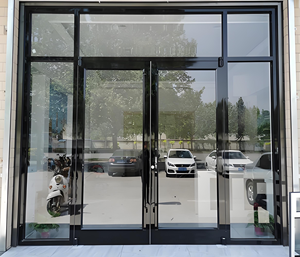
| Heavy-Duty Commercial Swing Storefront | $1.5 - 2.0 \text{ W/m}^2\text{K}$ | Class C4 / C5 (Up to 2000 Pa) | Class 9A (600 Pa) | $1400 \times 3200 \text{ mm}$ | High-traffic retail entrances, KFC/QSR store fronts, public infrastructure, office towers. |
| Automated Sliding Storefront Entrance | $1.6 - 2.2 \text{ W/m}^2\text{K}$ | Class C3 (1200 Pa) | Class 7A (300 Pa) | $1800 \times 3000 \text{ mm}$ per leaf | Supermarkets, hospital emergency entries, airport terminals, shopping malls. |
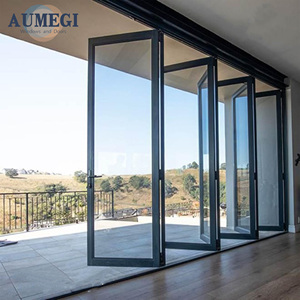
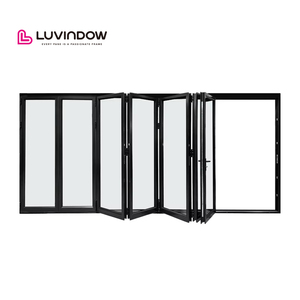
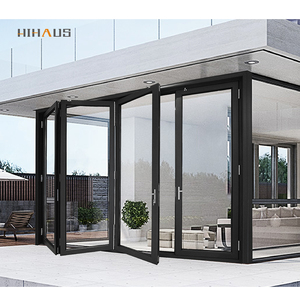
| Thermally Broken Bi-Folding Storefront | $1.3 - 1.8 \text{ W/m}^2\text{K}$ | Class C3 / C4 (1600 Pa) | Class 8A (450 Pa) | $1200 \times 3500 \text{ mm}$ per leaf | Automobile showrooms, indoor-outdoor restaurants, hospitality suites, villa entries. |
| Frameless / Structural Glass Storefront | $2.2 - 2.8 \text{ W/m}^2\text{K}$ | Class C2 / C3 (1000 Pa) | Class 5A (200 Pa) | $1500 \times 4000 \text{ mm}$ | Luxury retail boutiques, flagship brand stores, interior mall atrium entries. |
Frequently Asked Questions (FAQ) for Importers & Contractors
Comprehensive answers addressing technical specifications, factory audits, CE documentation, and logistics protocols.
How does your factory ensure compliance with CE certification under EN 14351-1?
Our manufacturing facility operates under an audited Factory Production Control (FPC) regime. Every order undergoes initial type testing (ITT) for mechanical strength, air permeability (EN 12207), watertightness (EN 12208), and wind load capacity (EN 12210). Upon dispatch, we provide a official Declaration of Performance (DoP) bearing CE marking, detailing exact $U_w$ values, glass acoustic ratings, and hardware compliance credentials.
What aluminum alloy grades and profile thicknesses are utilized for commercial shopfront doors?
We exclusively extrude primary 6063-T5 and structural 6063-T6 aluminum alloys. Commercial storefront door profiles feature heavy wall thicknesses ranging from 2.0mm to 3.0mm in load-bearing chambers, significantly exceeding residential window profiles (1.4mm) to resist heavy daily cycles and wind load deflections.
Can you customize shopfront door profiles to match existing architectural drawings and finishes?
Yes. As a factory-direct OEM/ODM manufacturer, we work directly from your DWG/DXF/BIM architectural files. Custom extrusion dies can be manufactured within 12–15 days. For surface treatments, we match any RAL powder coating color, offer anodized finishes (15–25 microns), or apply specialized architectural woodgrain foil finishes.
What is the typical production lead time for customized commercial shopfront door orders?
Standard factory production lead time is 35 to 45 days after finalized engineering shop drawings are signed off and deposit payments are verified. Rapid-track scheduling is available for large-scale commercial contracts. Sea freight transit times vary depending on the destination port (e.g., 14–20 days to Europe, 18–25 days to North America).
Do you offer complete shopfront glass integration or frame-only shipments?
We supply both options depending on your preference. We provide complete pre-glazed shopfront assemblies with double/triple glass installed, sealed, and calibrated at the factory. Alternatively, for importers wishing to source glass locally to reduce freight weight, we supply pre-assembled, knocked-down (KD) or fully assembled frames with pre-cut EPDM gaskets and structural glazing beads.
How are heavy commercial storefront doors packaged to prevent damage during ocean freight?
Every commercial door unit undergoes a multi-layer protective packaging sequence: 1) Surface protective film application, 2) EPE foam wrapping, 3) Heavy-duty corner guard placement, and 4) Crating inside custom-built steel-reinforced wooden crates or fumigated plywood boxes. Containers are secured with heavy-duty polyester strapping and airbag bracing to eliminate transit movement.
Which commercial door hardware brands do you integrate into your door leaf profiles?
We integrate top-tier international hardware including German ROTO, Siegenia, Dormakaba, GEZE, and Italian CISA mortise locks, continuous pin hinges, hydraulic floor springs, overhead door closers, and panic exit bars. We can also prep profile lock cutouts to accommodate client-specified localized lock cylinders or electronic access control systems.
Can SAGA provide sample window/door units for certifier or architectural review?
Yes. Standard-size profile corners or full-frame mockup samples can be manufactured and dispatched via DHL/FedEx air freight for client quality evaluation, physical inspection, and local certifier approval prior to full container production. Sample product costs are credited against the subsequent volume order.
Ready to Engineer Your Commercial Entrance System?
Submit your architectural drawings, window schedules, or project tender briefs today. Our fenestration structural engineers will return technical section details, CE compliance verification, and factory-direct pricing within 24 hours.