Featured China Aluminium Bifold Patio Doors
Factory-direct architectural bifold opening systems precision-engineered for commercial developments, luxury residential villas, and international distribution networks.
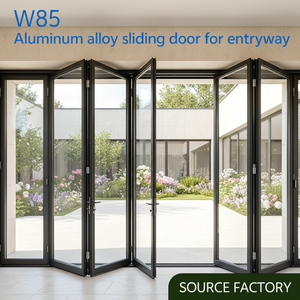
NFRC Aluminium Outdoor Accordion Door, Thermal Break Double Tempered Glass
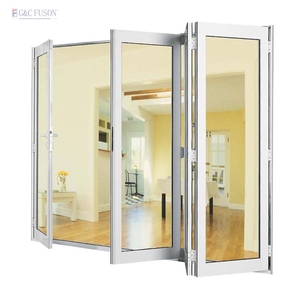
French Style Extruded Aluminum Frame Glass Door Living Room Folding Door
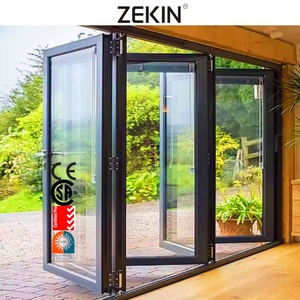
Aluminum Folding Doors Double Glass Bifold Patio Doors Outswing AS2047 CE
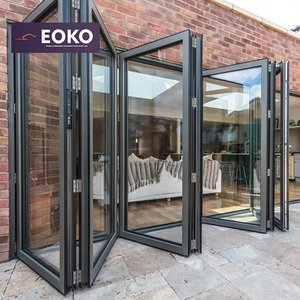
EOKO Residential Bifold Folding Door Low-E Glass Exterior Accordion Door
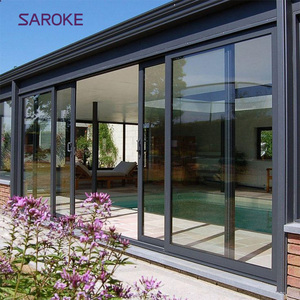
4 Panel Center Opening Exterior Aluminium Bifold Patio Doors with Flyscreen
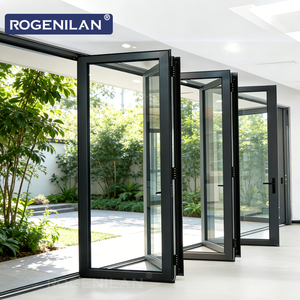
Exterior Double Glass Folding Foldable Door Energy Saving Storm Bifold System
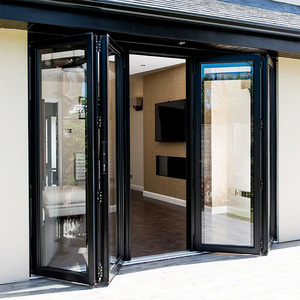
Modern Waterproof Bi Fold Doors Villa Exterior Aluminum Foldable Partition System
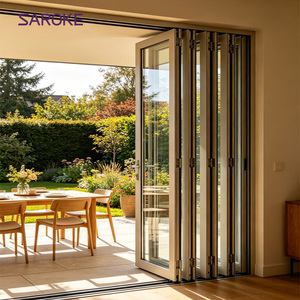
Modern Custom Aluminum Double Glass Bi-Fold Patio Doors Architectural Grade
Technical Sourcing Standards for China Aluminium Bifold Doors
An authoritative technical guide for architects, structural engineers, commercial builders, and B2B door importers selecting high-performance folding glass patio doors from Chinese manufacturers.
The Information Gain Advantage in Fenestration Procurement
Sourcing exterior aluminium bifold patio doors from China requires navigating structural wind pressure limits, thermal break material physics, glass performance metrics, and strict international building codes. Low-cost standard profiles often fail to meet long-term structural deflection requirements ($L/175$ or $L/250$) under high wind loads or trigger condensation due to inadequate thermal barrier insertion. High-tier Chinese manufacturers utilize precision-extruded 6063-T5/T6 structural aluminium alloys, advanced Technoform Polyamide PA66 GF25 thermal breaks, and heavy-duty multi-point locking hardware to engineer bifold systems that match or surpass European and North American benchmarks.
1. Extrusion Alloy Physics & Profile Geometry
Exterior bifold doors endure substantial operational torsion and wind pressures. Premium Chinese fabricators employ primary-grade 6063-T5 or 6063-T6 architectural aluminium extrusions with nominal wall thicknesses between 1.8mm and 3.0mm. Frame depths ranging from 75mm to 120mm allow deep glazing pockets capable of supporting triple-pane insulated glass units (IGUs) weighing up to 120kg per leaf.
2. Thermal Barrier Isolation Mechanics
Non-thermal break aluminium frames act as thermal bridges, resulting in massive energy loss and interior frame sweating. Modern high-efficiency bifold doors integrate PA66 GF25 (25% fiberglass reinforced polyamide) thermal break strips. This structural barrier decouples the exterior frame from the interior profile, lowering system U-factors down to $1.4 \text{ W/m}^2\text{K} \le U_w \le 1.8 \text{ W/m}^2\text{K}$ depending on glazing specification.
3. Heavy-Duty Carrier Tracks & Hardware
The operational longevity of accordion bifold doors depends on carrier wheel assemblies. Top-tier manufacturers feature stainless steel (SUS304/SUS316) top-hung or bottom-rolling quad-roller carriages engineered to endure over 100,000 duty cycles. Coupled with multi-point shoot-bolt locking systems, these hardware suites guarantee security against forced entry and wind-driven rain penetration.
Future Procurement & Technology Trends (2025–2030)
Key market shifts and engineering innovations shaping global procurement of architectural folding glass door systems over the next decade.
Ultra-Slim Sightlines & Structural Glass Bonding
Architects are increasingly specifying panoramic folding systems with narrow vertical stile sightlines (reduced from traditional 120mm to 45mm–60mm). To achieve structural integrity with slim frames, Chinese factories utilize structural silicone glazing (SSG) tech, bonding the tempered glass directly to the aluminium frame to transfer wind loads across the entire pane surface.
- Sightlines minimized to 48mm interlock profile
- Structural adhesive bonding increases frame rigidity by 35%
- Concealed hinges and flush threshold drain channels
Decarbonization & Low-Carbon Aluminium Sourcing
With global green building directives (LEED, BREEAM, NCC 2022 Section H1) tightening, importers require verified Environmental Product Declarations (EPDs). Leading Chinese manufacturers are transitioning to primary aluminium smelted via hydro-power or incorporating certified recycled scrap (up to 75%), drastically lowering embodied carbon metrics per unit area of fenestration.
- Low embodied carbon primary billets ($\le 4.0 \text{ kg CO}_2\text{e/kg Al}$)
- Third-party verified EPD documentation
- Fully recyclable polyamide and non-toxic powder coatings
Motorized Track Automation & Smart Integration
High-end residential and commercial hospitality projects are demanding automated motorized bifold systems. Embedded micro-actuators and heavy-duty motor drives enable quiet, push-button or smart-home app control for bifold spans reaching up to 12 meters in width, complete with integrated safety light curtains and rain sensor closure.
- Synchronized motorized track systems rated to 300kg/panel
- Obstacle detection & automatic reverse safety modules
- Integration with Zigbee, Z-Wave, and KNX automation
Global Fenestration Testing Benchmark Comparison
Verifiable structural, air infiltration, water resistance, and acoustic performance parameters required for global market access.
| Target Region / Standard | Wind Load Resistance (Structural) | Water Penetration Resistance | Air Leakage Rating | Acoustic Insulation (STC) |
|---|---|---|---|---|
| Australia / NZ (AS2047:2014 / NZS4211) |
1500 Pa – 4500 Pa (N4/N6, C1-C4 Cyclonic) | 300 Pa – 600 Pa (High Exposure) | < 1.5 L/s·m² (Air-conditioned spaces) | 32 dB – 42 dB (Double/Triple Low-E) |
| North America (NAFS / AAMA / WDMA) |
DP30 – DP70 Structural Load | 4.5 psf – 12.0 psf (Water Resistance) | < 0.30 cfm/ft² @ 1.57 psf | 34 STC – 44 STC (Acoustic Laminated) |
| Florida / Caribbean (Miami-Dade TAS 201/202/203) |
+70 / -70 psf Cyclic Wind Pressure | Pass 10.5 psf Water Head Test | Large Missile Impact (9lb 2x4 @ 50fps) | 38 STC – 45 STC (PVB SentryGlas) |
| European Union (EN 14351-1 / CE Mark) |
Class C4/C5 Wind Resistance | Class 9A (600 Pa Watertightness) | Class 4 Air Permeability (< 3 m³/h·m²) | Rw (C; Ctr) = 36 to 45 dB |
*Note: Performance ratings vary depending on specific door configuration, leaf dimensions, sub-frame anchoring, and glass build-up. Engineering calculations must be submitted for project certifier sign-off.
Why Direct Sourcing from SAGA Guarantees High-Yield ROI
Combining 16 years of OEM export experience with rigorous quality management system (QMS) frameworks to eliminate risk for international buyers.
Custom CNC Machining & Extrusion Control
Our state-of-the-art manufacturing facility features 5-axis CNC machining centers for automatic hinge recessing, lock box milling, and corner key crimping. Perfect dimensional accuracy ($\pm 0.5\text{mm}$) ensures airtight frame alignment on job sites.
Certified Surface Coatings (Qualicoat Class 2)
Salt spray and UV resistance are paramount for coastal patio doors. Our architectural powder coating line adheres to Qualicoat Class 2 standards and AkzoNobel Interpon fluorocarbon (PVDF) formulations, resisting color fading and chalking for up to 20 years in marine environments.
Export Packing & Logistics Mastery
Each bifold panel is wrapped in protective PE film, edge-shielded with corner guards, and sealed in fully enclosed fumigated plywood crates. Optimized container loading plans ensure zero glass damage during ocean transport from Fuzhou or Xiamen ports.
Frequently Asked Questions (FAQ) for Importers & Contractors
In-depth answers to common engineering, commercial, and logistical questions when importing aluminium bifold patio doors from China.
Q1: How do I verify that Chinese bifold doors comply with my local building codes (e.g., AS2047, NZS4211, NAFS)?
Reputable manufacturers undergo annual audits by accredited independent testing bodies (such as AGWA for Australia or NAFS laboratory testing in North America). Always request certified test reports specifying structural wind deflection, water tightness pressure, air infiltration rates, and sample door dimensions to ensure the test certificate covers your project's panel height and width.
Q2: What is the difference between top-hung and bottom-rolling bifold carrier systems, and which should I choose?
Top-hung bifold systems suspend the door panel weight from the top header track. They offer smoother gliding operation and allow ultra-flush floor tracks, but require a heavy structural lintel to support the ceiling load. Bottom-rolling systems place the weight load directly on the floor track, making them ideal for retrofit projects where the top beam cannot handle structural load, though bottom tracks require proper drainage channels.
Q3: Why is thermal break technology recommended for exterior bifold patio doors?
Aluminium is a highly conductive metal ($k \approx 160-200 \text{ W/m}\cdot\text{K}$). Without a thermal break, outdoor heat or cold transfers directly into the room, raising energy costs and triggering condensation. Polyamide PA66 GF25 thermal breaks insert a low-conductivity barrier ($k \approx 0.3 \text{ W/m}\cdot\text{K}$), reducing heat transfer by up to 60% and ensuring strict energy code compliance (NCC 2022 H1 / Title 24).
Q4: What glazing configurations provide optimal acoustic soundproofing for villa patio doors?
For high sound reduction (STC 38–42 dB), we recommend double or triple-pane insulated glass units (IGUs) with asymmetric glass thickness (e.g., 6mm toughened outer + 12mm Argon air space + 8.38mm acoustic laminated inner). The PVB or SGP acoustic laminate dampens mid-to-high frequency airborne noise from traffic or urban surroundings.
Q5: What is the typical lead time from shop drawing approval to destination port delivery?
Standard production lead time is 35 to 50 days following CAD shop drawing sign-off and deposit receipt. Ocean transit times vary by port: 12–18 days to Australia/NZ, 18–25 days to US West Coast, 30–38 days to US East Coast/Europe, and 35–40 days to the Caribbean.
Q6: How do Chinese factories prevent water leakage at the sill track of bifold doors during heavy rain?
Waterproofing relies on a integrated multi-stage drainage design: stepped sub-head flashings, continuous EPDM gasket seals, continuous sill drain trays with one-way weep hole valves, and high-performance weather-stripping along panel interlocks. Standard high-exposure frames pass 450Pa–600Pa static water penetration tests.
Q7: Can bifold patio doors be fitted with flyscreens or security mesh?
Yes. Modern bifold systems can be specified with integrated retractable pleated screens or heavy-duty stainless steel 304 security mesh screens. Dual-track profiles allow the glass panels to fold to one side while the insect screen slides seamlessly from the opposite side.
Q8: Are custom frame colors, anodized finishes, and woodgrain options available for B2B orders?
We offer a broad range of architectural surface finishes: RAL custom powder coats, PVDF fluorocarbon coatings, hard anodized finishes (15–25 microns), and heat-transfer Italian woodgrain foils. Dual-color profiles (e.g., Matt Black exterior + Warm Walnut interior) are available for thermally broken systems.
Q9: What warranty coverage is provided on factory-supplied bifold systems?
SAGA offers a 10-year comprehensive warranty covering structural extrusion integrity and surface coating durability, alongside a 5-year warranty on glass sealed units and mechanical hardware (ROTO, Siegenia, Kinlong).
Q10: What technical drawings and engineering support are included before production starts?
Every project receives full CAD shop drawings detailing section profiles, anchorage points, frame dimension schedules, glass specs, structural wind load calculations, and installation flashing details for architect and building certifier review.