Engineering Architectural Excellence: The Technical Mechanics of Aluminium Vertical Doors
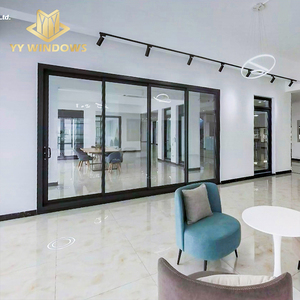
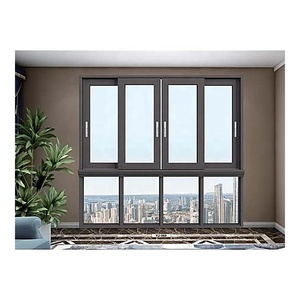
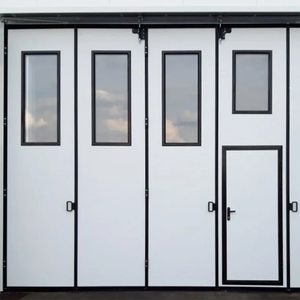
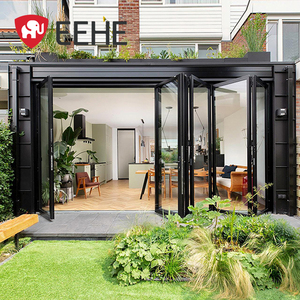
In contemporary commercial and high-end residential architecture, the perimeter envelope is no longer viewed merely as a static barrier; it is an adaptable engineering interface. Selecting a premier China aluminium vertical door manufacturer requires looking beyond aesthetic appeal to evaluate fundamental structural integrity, thermokinetic performance, hardware metallurgy, and wind-load resistance coefficients. Vertical doors—incorporating bi-fold accordion configurations, vertical-lift bi-folding panels, commercial overhead glass sections, and high-span heavy-duty entrances—represent the apex of architectural joinery.
As structural specifications become more demanding under updating building codes such as Australia's NCC 2022, North America's NAFS, and Florida’s rigorous Miami-Dade TAS 201/202/203 hurricane protocols, facade engineers and commercial procurement directors require comprehensive technical clarity. SAGA Doors & Windows operates at the intersection of material science and structural engineering, fabricating custom extrusion systems derived from primary-grade 6063-T5 and 6060-T66 aluminum alloys.
Technical Information Gain: Standard commercial vertical doors often suffer from structural sagging and air infiltration under cyclical wind pressure. SAGA integrates multi-cavity polyamide thermal breaks (PA66 GF25) paired with custom stainless steel 304/316 top-hung tandem rollers rated for over 100,000 continuous operation cycles without axial deflection.
Metallurgical Analysis: Extrusion Alloys in Structural Vertical Doors
The operational lifespan of a vertical folding or swing door system relies on the yield strength of its underlying aluminum profiles. Standard architectural extrusions frequently utilize generic scrap-blended alloys that corrode under coastal saline exposure or flex under high static wind pressure. The table below outlines the structural metallurgical thresholds enforced across SAGA's manufacturing lines:
| Aluminum Alloy & Temper | Tensile Strength (MPa) | Yield Strength (MPa) | Hardness (Webster) | Primary Application in Vertical Doors |
|---|---|---|---|---|
| 6063-T5 (Standard) | ≥ 185 | ≥ 145 | ≥ 8.0 | Secondary sash profiles, interior glass partitions, lightweight interior sliding frames. |
| 6063-T6 (High Precision) | ≥ 205 | ≥ 180 | ≥ 11.5 | Structural bi-fold outer frames, commercial heavy-duty swing doors, outer tracks. |
| 6061-T6 (Structural Grade) | ≥ 290 | ≥ 240 | ≥ 15.0 | Large-span vertical lift door load-bearing mullions, hurricane impact reinforcements. |
| 6060-T66 (Specialty Thermal) | ≥ 215 | ≥ 160 | ≥ 10.0 | Complex multi-chamber thermal break profiles engineered for passive house specs. |
Enterprise Strengths & Factory Verification (SAGA Quality Matrix)
SAGA Aluminum Doors & Windows Co., Ltd. brings over 16 years of direct manufacturing expertise to the global export landscape. Operating out of Minhou County, Fuzhou, Fujian, our manufacturing center integrates automated CNC profile processing centers, robotic corner-crimping units, and dual-color electrostatic powder-coating lines. We deliver complete structural joinery packages engineered directly to client architectural drawings.
Audited Global Compliance
Fully compliant with AS2047:2014, AS1288:2021 (AGWA Accredited), NZS4211:2008, NAFS, and Miami-Dade impact standards with complete test reports.
Advanced BIM & CAD Support
Our engineering team generates detailed shop drawings, section profiles, structural wind calculations, and installation guides for certifiers and architects.
Strict 35-50 Day Lead Times
Standardized manufacturing protocols allow predictable production schedules, supported by containerized crate packaging loaded directly at Fuzhou or Xiamen ports.
Structural Mechanics: Preventing Water Infiltration & Frame Deflection
A critical engineering failure in low-grade vertical doors is water penetration along the bottom sill and inter-panel vertical joints during wind-driven rain events. SAGA addresses this through a tri-sealed gasket architecture incorporating continuous EPDM (Ethylene Propylene Diene Monomer) weatherstripping coupled with concealed internal drainage channels.
To quantify wind load resistance, SAGA engineers evaluate structural deflection ($S$) using the structural wind pressure formula:
Wind Pressure Formula: \( P = 0.613 \cdot V^2 \cdot K_z \cdot K_{zt} \cdot K_d \)
Where \(V\) is basic wind speed (m/s), \(K_z\) is velocity pressure exposure coefficient, and \(P\) is design wind pressure (N/m²). SAGA vertical doors maintain a deflection limit below \(L/240\), preventing glass edge stress and frame distortion under extreme storm conditions.
Product Evolution & Technological Trends in Aluminium Doors
The architectural hardware sector is undergoing a rapid evolution driven by energy performance mandates and space-optimization trends. Traditional hinged and heavy sliding doors are increasingly replaced by sophisticated vertical folding, hidden-frame accordion, and motorized vertical lift systems.
1. Ultra-Slim Sightlines & Structural Glazing
Modern commercial specifications demand maximum glass surface areas. The industry has shifted toward ultra-narrow vertical stiles (as slim as 28mm–35mm) using structural silicone bonding (Dow Corning 983) to transfer lateral wind loads directly into the insulated glass unit (IGU).
2. Multi-Chamber Thermal Insulation
With global green building directives (LEED, Passive House, NCC 2022 H1), solid aluminum profiles are obsolete for exterior envelopes. Modern vertical doors incorporate 24mm to 34mm polyamde strips (PA66 GF25) filled with aerogel or expanded polyurethane foam, achieving door U-factors ($U_w$) as low as \(0.95 \text{ W/m}^2\text{K}\).
3. Smart Access & Motorized Vertical Actuation
Commercial storefronts and luxury patio venues are moving toward automated vertical folding mechanisms. Synchronized linear actuators and concealed belt drives allow heavy double-glazed vertical sections (up to 400kg per panel) to lift effortlessly via smart home automation or push-button interfaces.
Future Procurement Trends in B2B Aluminium Door Sourcing
Global procurement directors, real estate developers, and wholesale importers are changing how they source structural architectural joinery from China. Strategic buyers no longer focus solely on unit price per square meter; procurement models now prioritize total lifecycle cost, supply chain transparency, and compliance risk mitigation.
1. Decarbonized Low-Carbon Aluminum Billets
With Europe's Carbon Border Adjustment Mechanism (CBAM) and strict Scope 3 emission targets, leading developers require verified Environmental Product Declarations (EPD). SAGA utilizes low-carbon aluminum billets smelted using renewable hydro-power, reducing embedded carbon footprints from the industry average of \(18\text{ kg CO}_2/\text{kg Al}\) down to under \(4.0\text{ kg CO}_2/\text{kg Al}\).
2. Consolidated Envelope Sourcing (Door + Window + Balustrade Packages)
Managing multiple suppliers for windows, entrance doors, interior dividers, glass balustrades, and roller shutters introduces site installation misalignments and paint finish mismatches. Modern builders opt for single-factory consolidated shipments. SAGA provides integrated envelope production—ensuring identical powder-coat batch codes (e.g., Dulux or AkzoNobel finishes) across all architectural joinery elements.
3. Knock-Down (KD) vs. Pre-Assembled Freight Optimization
Ocean freight economics have transformed container packing strategies. While fully assembled bifold doors reduce site labor, they incur high shipping volume costs. SAGA offers precision-engineered Knock-Down (KD) vertical door framing kits with pre-machined corner cleats and drop-in gasket systems, allowing importers to double the square meter volume packed per 40ft HQ container while maintaining simple 15-minute frame assembly on site.
Comprehensive Structural Performance Comparison Matrix
To assist architects and procurement managers in selecting the ideal vertical entrance geometry, the matrix below details the structural and environmental limits of primary door opening configurations manufactured by SAGA:
| Door System Type | Max Panel Height (mm) | Thermal U-Factor ($W/m^2K$) | Acoustic Rating ($Rw / STC$) | Max Wind Load Pressure | Best Architectural Fit |
|---|---|---|---|---|---|
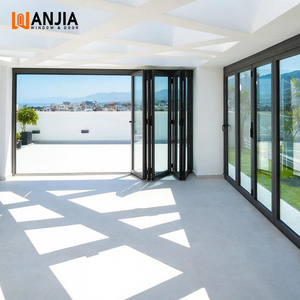
| Heavy-Duty Coastal Bifold | 3500 mm | 1.2 – 1.6 | 38 – 42 dB | up to 4.5 kPa | Luxury beachfront villas, restaurant openings, high-wind balconies. |
| NFRC Soundproof Sliding Dividers | 3000 mm | 1.4 – 1.8 | 35 – 40 dB | 2.5 kPa | Interior room dividers, commercial office suites, residential patios. |
| Motorized Vertical Accordion Lift | 4500 mm | 1.1 – 1.5 | 36 – 41 dB | 3.8 kPa | Auto showrooms, commercial bar fronts, luxury residential garages. |
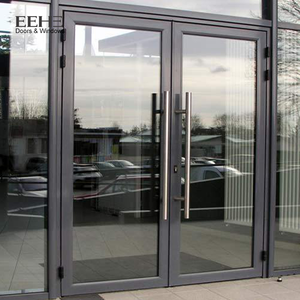
| Commercial Double Swing Entrance | 2800 mm | 1.5 – 2.0 | 32 – 36 dB | 3.0 kPa | Supermarket entrances, high-traffic retail storefronts, office lobbies. |
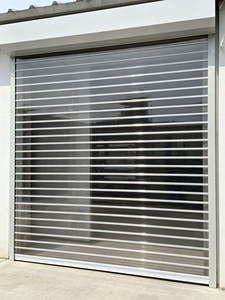
| Smart Clear Roller Shutters | 5000 mm | N/A (Uninsulated) | 22 – 26 dB | 2.0 kPa | Shopping mall fronts, warehouse security bays, industrial counters. |
Frequently Asked Sourcing & Technical Procurement FAQs
Q: Which international standards do SAGA aluminium vertical doors comply with?
SAGA door systems are fully tested and audited for key regional building codes. For Australia and New Zealand, our products comply with AS2047:2014, AS1288:2021, and NZS4211:2008 under AGWA accreditation. For North America, we provide NAFS physical test reports and NFRC thermal ratings. For hurricane-prone regions, our systems carry Miami-Dade TAS 201/202/203 large missile impact compliance.
Q: What is the typical lead time for custom manufacturing and export shipping?
Standard factory production lead time is 35 to 50 calendar days following shop drawing sign-off and deposit receipt. Shipping transit times depend on the destination port (e.g., 14–20 days to Australian East Coast, 22–30 days to US West Coast/East Coast). Orders are safely packed in steel-reinforced plywood crates and shipped directly from Fuzhou or Xiamen ports.
Q: How does SAGA ensure frame color consistency and corrosion resistance?
We utilize premium architectural-grade powder coatings from Dulux and AkzoNobel (AAMA 2604 / AAMA 2605 standards) as well as anodized finishes up to 25 microns. All extrusions undergo a multi-stage pre-treatment etching process to guarantee 10+ years of resistance against coastal salt spray, UV fading, and micro-cracking.
Q: Can SAGA supply custom product samples for commercial tender evaluations?
Yes. SAGA provides physical corner samples demonstrating thermal breaks, glass build-ups, and extrusion wall thickness, as well as full-scale standard-size sample units for laboratory testing or client mockup reviews. Sample units are provided free of charge, with courier or freight costs covered by the importer.
Q: What engineering documentation is provided prior to production?
Every commercial or residential order receives comprehensive technical sign-off packages. This includes 2D section CAD drawings, 3D BIM models (Revit format), glass stress calculations, wind pressure compliance certificates, and step-by-step installation manuals tailored for local site crews.
Q: What payment terms and order safeguards are available for overseas buyers?
We offer flexible B2B trade terms including standard T/T (Telegraphic Transfer) bank payments (30% deposit, 70% balance prior to shipment) as well as Alibaba Trade Assurance protection to ensure funds are secured until goods pass pre-shipment inspection.
Partner with China’s Premier Aluminium Vertical Door Manufacturer
Whether you are detailing a high-end coastal residence, a multi-unit commercial development, or establishing a regional wholesale window distribution network, SAGA delivers engineered quality backed by audited performance.