Executive Industry Analysis: The Evolution of Modern Architectural Aluminum Roll Up Doors
Over the past decade, global demand for high-performance architectural closure systems has undergone a paradigm shift. Commercial developers, industrial logistics facility specifiers, luxury residential architects, and building materials wholesalers are increasingly moving away from traditional galvanized steel rolling shutters toward advanced extruded aluminum roll up door systems. China's manufacturing clusters—most notably in Fujian and Foshan—have established absolute technical leadership in precision aluminum extrusion, automated thermal-break polyurethane injection, and extreme weather wind-lock mechanics.
As international energy codes tighten—such as Australia’s NCC 2022 building envelope efficiency mandate, New Zealand's updated H1 thermal performance regulations, and North America’s NAFS / Miami-Dade structural hurricane codes—the modern aluminum roll-up door is no longer evaluated merely as a mechanical barrier. It is analyzed as an integrated building envelope element engineered for structural wind loading, thermal isolation, forced-entry resistance, acoustic damping, and long-term cycle reliability.
Enterprise Capabilities & OEM/ODM Manufacturing Infrastructure
16+ Years Manufacturing Rigor
Over 16 years of direct factory experience producing customized architectural joinery, thermally broken aluminum rolling shutters, and hurricane-impact structural assemblies for premier global export markets.
Global Standard Compliance
Audited compliance under the AGWA program for Australian AS2047:2014 & AS1288:2021, New Zealand NZS4211:2008, North American NAFS, and Miami-Dade TAS 201/202/203 high-velocity hurricane certifications.
Precision Tooling & CNC Machining
State-of-the-art aluminum extrusion lines, automated double-walled slat roll-forming, polyurethane core injection, and CNC end-lock crimping ensure millimeter-perfect dimensional tolerances.
Dual Port Logistics Efficiency
Strategic production facilities located with direct access to Fuzhou and Xiamen ocean ports, ensuring streamlined containerized sea freight shipping with custom ISPM-15 export wood crate packaging.
End-to-End Technical Support
Full CAD shop drawings, 3D section details, wind-load calculation modeling, and specialized installation guide documentation provided for architectural review before production sign-off.
10-Year Structural Warranty
Backed by stringent pre-shipment quality control, 100% mechanical drive and finish testing, and high-durability Qualicoat Class 2 powder coating finishes resistant to marine salt-spray corrosion.
Mechanical Engineering & Profile Metallurgy: Anatomic Deep-Dive
To understand why leading Chinese manufacturers dominate the global architectural aluminum roll-up door market, importers must evaluate the exact engineering sub-assemblies that constitute a heavy-duty industrial or high-end residential curtain system.
Technical Focus: Extruded Slats vs. Foam-Filled Roll-Formed Slats
Chinese factories specialize in two distinct slat profiles depending on the functional brief: Heavy-Duty Structural Extrusions (EN AW-6063 T5/T6) and Polyurethane Insulated Double-Walled Slats. Structural extruded profiles utilize wall thicknesses ranging from 1.2mm to 3.0mm, achieving tensile strength exceeding 205 MPa. Double-walled insulated slats feature high-density (45-55 kg/m³) CFC-free polyurethane cores, delivering thermal conductivity values as low as U = 1.4 W/m²K while drastically muffling operational acoustic transfer.
Key Structural Components & Metallurgy Specifications
- Structural Alloy Profiles: Extruded from 6063-T5 or 6063-T6 architectural grade aluminum alloy. Possesses superior anodizing performance and corrosion resistance compared to 6061 or standard steel alternatives.
- Wind Lock Guide Rail Architecture: For typhoon and hurricane zones, heavy-duty side tracks are fitted with continuous cast aluminum or nylon wind-lock clips. When exposed to negative pressure wind loads, the wind locks engage internal track grooves, preventing curtain blowout under wind speeds up to 250 km/h (compliant with Miami-Dade TAS 202).
- Thermal Break Polyamide Integration: Advanced rolling shutter profiles incorporate PA66GF25 (25% fiberglass reinforced polyamide) structural thermal breaks, preventing thermal bridging in extreme cold or scorching climates.
- Surface Finish Technology: Treated with AkzoNobel or PPG Fluorocarbon (PVDF) spray coatings or Qualicoat-certified architectural thermosetting powder coatings. Ensures 15-20 years of UV resistance without chalking, fading, or filiform corrosion in coastal marine environments.
- Automated Drive Systems & Controls: Powered by high-torque tubular motors or side-mounted industrial chain drives with integrated electromagnetic braking systems, optical safety sensors, manual emergency release cranks, and smart IoT control cards (RS485 / Zigbee).
Future Procurement & Technological Trends (2025–2030)
As the international construction industry transitions toward net-zero operational carbon and smart facility management, the specification criteria for aluminum roll-up doors are evolving rapidly. Global procurement teams must align with several macro trends shaping Chinese factory production lines:
1. Ultra-Narrow Sightlines & Perforated Micro-Slat Ventilation
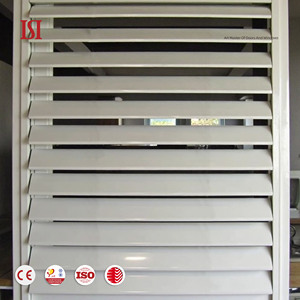
Architects are requesting minimalist rolling shutter profiles featuring micro-perforations. These allow natural day-lighting and controlled ventilation while maintaining privacy and insect defense when the curtain is partially deployed.
2. Photovoltaic & Energy Harvesting Integration
Next-generation commercial garage and warehouse roll-up doors are adopting flexible thin-film BIPV (Building-Integrated Photovoltaic) solar cells layered directly onto outer slat surfaces, feeding power back into facility microgrids.
3. High-Speed Frequency-Controlled Drive Motors
Replacing traditional AC single-speed tubular motors with VFD (Variable Frequency Drive) brushless servo motors. Operating speeds increase from standard 0.15 m/s up to 1.5 m/s, drastically reducing thermal energy loss in cold-storage and logistics facilities.
Architectural Closure Systems: Performance Comparison Matrix
| Evaluation Parameter | Extruded Aluminum Roll Up Door | Galvanized Steel Roller Shutter | Overhead Sectional Garage Door | Aluminum Sliding Patio Door |
|---|---|---|---|---|
| Structural Wind Load | Extreme (Wind Lock Engaged) | High (Heavy Weight) | Moderate to High | Moderate (Glass Limit) |
| Corrosion Resistance | Superior (0% Rust, Marine Powder Coating) | Poor to Moderate (Rust at cut edges) | Moderate (Steel Skins) | Superior (Anodized/PVDF Aluminum) |
| Weight-to-Strength Ratio | Optimal (Low motor load) | Heavy (High motor wear) | Moderate | Heavy (Double/Triple Glass) |
| Space Efficiency | Maximum (Tight Overhead Roll) | Maximum (Rolled Box) | Requires Ceiling Track Depth | Requires Floor Track Width |
| Thermal Insulation (U-Value) | 1.4 - 2.2 W/m²K (Insulated Slat) | 3.8 - 5.5 W/m²K (Single Slat) | 1.2 - 1.8 W/m²K (PU Panel) | 1.1 - 1.6 W/m²K (Low-E Double Glass) |
| Cycle Lifespan (Operations) | 50,000 - 100,000 Cycles | 20,000 - 30,000 Cycles | 25,000 Cycles (Spring wear) | 100,000 Cycles (Roller wear) |
Strategic Guide: Auditing & Partnering with Chinese Factories
Selecting the right OEM/ODM manufacturer in China is a critical decision for procurement managers, project contractors, and regional distributors. Mitigate supply chain risks by implementing a strict 5-stage auditing framework:
1. Verify Alloy Mill Certificates
Demand certified EN 10204 3.1 mill test certificates confirming alloy composition (6063-T5/T6) to prevent suppliers from substituting recycled or lower-grade scrap aluminum alloy.
2. Audit Powder Coating Thickness
Specify minimum dry film thickness (DFT) of 60–80 microns for polyester powder coatings and 30–40 microns for PVDF fluorocarbon finishes. Verify salt spray testing reports (ISO 9227 / ASTM B117) exceeding 1,000 hours.
3. Hardware Brand Authenticity
Ensure motor drives, safety edge sensors, and manual overrides use verified brands (e.g., Somfy, Becker, or premium tier-1 domestic drive manufacturers like Dooya/Geiger) with CE and UL safety markings.
Frequently Asked B2B Procurement Questions (FAQ)
Transform Your Project Brief into an Engineering Proposal
Submit your architectural drawings, window/door schedules, or technical performance specifications to our senior engineering team for rapid consultation and competitive factory-direct pricing.